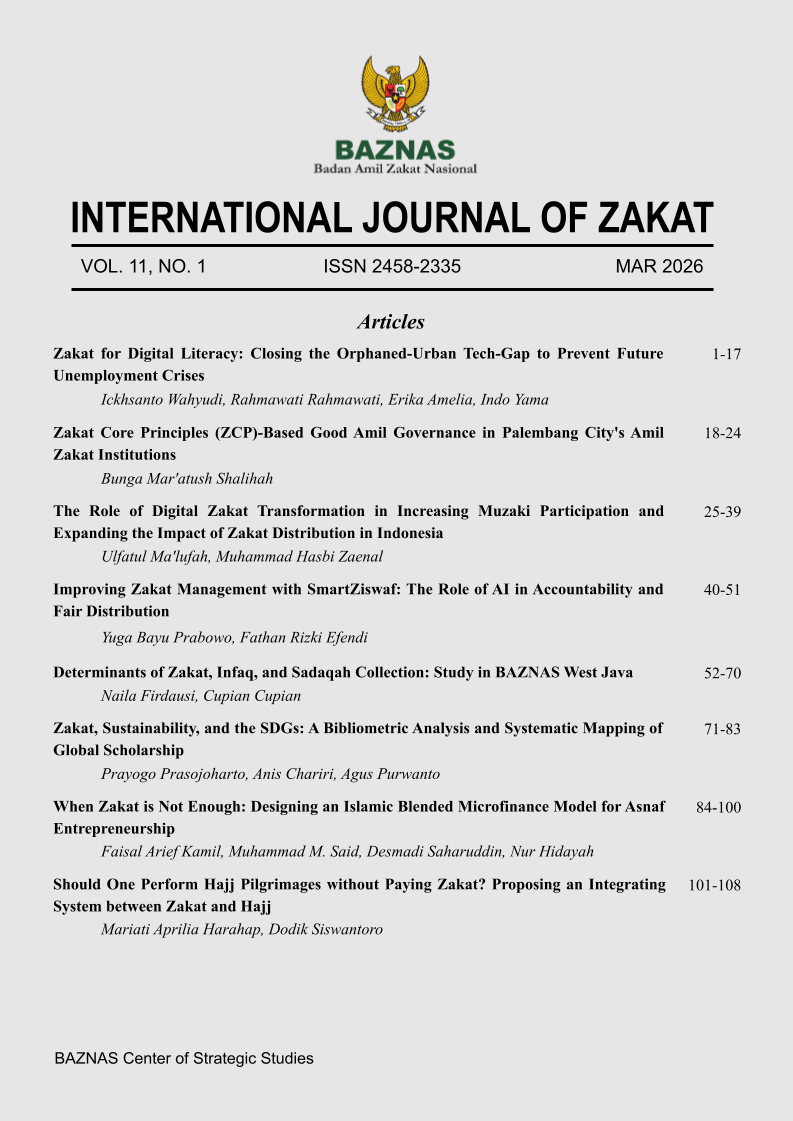
When Zakat is Not Enough: Designing an Islamic Blended Microfinance Model for Asnaf Entrepreneurship
DOI:
https://doi.org/10.37706/ijaz.v11i1.795Keywords:
Productive Zakat, Blended Microfinance, Institutional Logics, Pentahelix, Asnaf EmpowermentAbstract
Purpose
This study aims to develop an integrated financing model to strengthen the economic empowerment of asnaf in Indonesia and to address structural weaknesses in current zakat-based empowerment practices.
Design/Methodology/Approach
The study uses a qualitative conceptual and comparative approach. It analyzes existing zakat empowerment practices and synthesizes three theoretical frameworks. These frameworks are the microfinance schism between institutionalist and welfarist perspectives, institutional logics, and the Pentahelix collaboration model.
Findings
The study identifies a key paradox. National data show a link between entrepreneurship growth and poverty reduction, yet the share of zakat allocated to productive empowerment declined to 5.1 percent in 2025 Semester 1. Zakat institutions continue to prioritize short-term charitable programs. The main challenges include weak integration between zakat and waqf, limited long-term mentoring, and tension between market efficiency and socio-religious obligations to serve high-risk asnaf. To respond, the study proposes the Islamic Blended Microfinance Model. This model positions zakat and waqf as first-loss capital to absorb risk and enable Islamic microfinance institutions to mobilize commercial financing for asnaf who are currently unbankable.
Research limitations/implications
The study is conceptual and does not test the model empirically. Future research can apply the model in pilot programs and evaluate its impact on income growth, business sustainability, and graduation from mustahik to muzakki.
Practical implications
The model offers a clear policy blueprint for BAZNAS, BWI, and Islamic microfinance institutions to shift from charity-based disbursement toward structured capacity-building and risk-sharing financing schemes.
Social implications
The proposed model strengthens the role of Islamic social finance in sustainable poverty reduction. It supports inclusive entrepreneurship and expands access to financing for vulnerable groups who are excluded from formal financial systems.
Originality/value
This study introduces an original integrative model that connects zakat, waqf, and Islamic microfinance within a blended finance and Pentahelix governance framework. It contributes a new conceptual foundation for aligning Islamic social finance with long-term development and empowerment goals.
Downloads
References
Asni, F., Yusli, Y., & Zulkifli, M. I. (2025). Empowering asnaf entrepreneurs: A sustainable zakat framework through microcredit financing – qard hasan in Malaysia. Journal of Islamic Accounting and Business Research. https://doi.org/10.1108/JIABR-11-2024-0442
Asutay, M., Aziz, P. F., Indrastomo, B. S., & Karbhari, Y. (2023). Religiosity and Charitable Giving on Investors’ Trading Behaviour in the Indonesian Islamic Stock Market: Islamic vs Market Logic. Journal of Business Ethics, 188(2), 327–348. https://doi.org/10.1007/s10551-023-05324-0
Azman, N. H. N., Masron, T. A., & Ibrahim, H. (2021). The significance of Islamic social finance in stabilising income for micro-entrepreneurs during the COVID-19 outbreak. Journal of Islamic Monetary Economics and Finance, 7(Special Issue 1), 115–136.
Azwar, H., Hanafiah, M. H., Zahari, M. S. M., Gani, A. A., & Ferdian, F. (2025). Does Penta-Helix Multi-Stakeholder Collaboration Serve as a Sustainable Development Strategy for Community-Based Tourism (CBT)?: A Qualitative Inquiry of Agam Regency, Indonesia. Tourism Planning & Development, 1–26. https://doi.org/10.1080/21568316.2025.2540535
Besharov, M. L., & Smith, W. K. (2014). Multiple Institutional Logics in Organizations: Explaining Their Varied Nature and Implications. Academy of Management Review, 39(3), 364–381. https://doi.org/10.5465/amr.2011.0431
Bhatt, N., & Tang, S. (2001). Delivering Microfinance in Developing Countries: Controversies and Policy Perspectives. Policy Studies Journal, 29(2), 319–333. https://doi.org/10.1111/j.1541-0072.2001.tb02095.x
Delima Afriyanti, Ahda Segati, & Landes Yuanda. (2024). Philanthropy: Developing a Productive Zakat-Based UMKM Empowerment Model at Baznas of Pekanbaru City. International Journal of Economics, Commerce, and Management, 1(4), 289–311. https://doi.org/10.62951/ijecm.v1i4.243
Etzkowitz, H. (2003). Innovation in Innovation: The Triple Helix of University-Industry-Government Relations. Social Science Information, 42(3), 293–337. https://doi.org/10.1177/05390184030423002
Gümüsay, A. A. (2020). The Potential for Plurality and Prevalence of the Religious Institutional Logic. Business & Society, 59(5), 855–880. https://doi.org/10.1177/0007650317745634
Habbel, V., Jackson, E. T., Orth, M., Richter, J., & Harten, S. (2021). Evaluating blended finance instruments and mechanisms: Approaches and methods. OECD Development Co-operation Working Paper No. 101. Organisation for Economic Co-operation and Development.
Haji-Othman, Y., Sheh Yusuff, M. S., & Ahmad, S. S. (2025). A Proposed Financial Inclusion Model Integrating Zakat, Waqf, and Islamic Crowdfunding for Sustainable Poverty Alleviation in Supporting Ekonomi MADANI. Environment-Behaviour Proceedings Journal, 10(SI33), 181–186. https://doi.org/10.21834/e-bpj.v10iSI33.7082
Hidayah, N. (2023). Gender, Economy, and the Law: Women Entrepreneurs in Indonesian and Islamic Legal Perspectives. Samarah: Jurnal Hukum Keluarga Dan Hukum Islam, 7(2), 1171. https://doi.org/10.22373/sjhk.v7i2.17944
Hidayah, N., & Ade, N. S. (2023). Preferences for Donating to Religious and Non-Religious Philanthropic Institutions: Evidence in Indonesia. Signifikan: Jurnal Ilmu Ekonomi, 12(1), 191–206. https://doi.org/10.15408/sjie.v12i1.27887
Hidayah, N., Mutiara, T., Hosen, M. N., Larasati, D., & Wahab, A. (2023). Public perception of the revitalization of Indonesian Waqf Institution. EKONOMIKA SYARIAH : Journal of Economic Studies, 7(1), 72. https://doi.org/10.30983/es.v7i1.6297
Hidayah, N., Wastuti, W., & Nasution, S. (2023). The Role of Financing and Zakat on the Performance of Indonesian Islamic Banks. Proceedings of the 3rd International Conference of Islamic Finance and Business, ICIFEB 2022, 19-20 July 2022, Jakarta, Indonesia. Proceedings of the 3rd International Conference of Islamic Finance and Business, ICIFEB 2022, 19-20 July 2022, Jakarta, Indonesia, Jakarta, Indonesia. https://doi.org/10.4108/eai.19-7-2022.2329724
Hosen, M. N., Hidayat, R., Hidayah, N., & Lathifah, F. (2025). Does empowerment have an influence on achieving effectiveness of mustahik improvement in social Islamic finance management? Journal of Islamic Banking and Finance, 42(3), 35–59.
Hosen, M. N., Hidayat, R., Hidayah, N., & Lathifah, F. (2024). The management of productive zakat in Indonesia: The case of Baznas' economic empowerment program. Signifikan: Jurnal Ilmu Ekonomi, 13(2), 455–474 . https://doi.org/10.15408/sjie.v13i2.42673
Ibrahim, P., Ali, M., Muridan, M., & Mohd Jazid, A. I. (2020). Revisiting Zakat Distribution on Income Inequality and Welfare: The Malaysia Experience. Al-Uqud : Journal of Islamic Economics, 4(1), 146. https://doi.org/10.26740/al-uqud.v4n1.p146-161
Iqbal, M., Sukmana, R., & Harymawan, I. (2023). Hybridization: How Does a Waqf Institution Manage Its Complexity? Evidence from Yayasan Wakaf UMI. IQTISHODUNA: Jurnal Ekonomi Islam, 12(1), 265–282. https://doi.org/10.54471/iqtishoduna.v12i1.2225
Jatmiko, W., Azizon, A., & Sukmana, R. (2025). On the Design of Islamic Blended Microfinancing for Refugee Entrepreneurship: An Institutional Logic Perspective. Global Policy, 16(S1), 25–37. https://doi.org/10.1111/1758-5899.13475
Joremi, L., Muda, R., Mohd Zain, W. Z. W., & Rosli, N. A. (2023). The Challenges of Asnaf Entrepreneurs in Forming Entrepreneurial Resilience. Information Management and Business Review, 15(3(I)), 242–252. https://doi.org/10.22610/imbr.v15i3(I).3533
Kamarubahrin, A. F., & Ahmed Ayedh, A. M. (2018). Critical Review on Waqf Experiences: Lessons from Muslim and Non-Muslim. IQTISHADIA, 11(2), 332. https://doi.org/10.21043/iqtishadia.v11i2.3272
Khan, T., & Badjie, F. (2022). ISLAMIC BLENDED FINANCE FOR CIRCULAR ECONOMY IMPACTFUL SMEs TO ACHIEVE SDGs. The Singapore Economic Review, 67(01), 219–244. https://doi.org/10.1142/S0217590820420060
Maulana, H., & Umam, K. (2018). Identifying Financial Exclusion and Islamic Microfinance as An Alternative to Enhance Financial Inclusion. International Journal of Islamic Business and Economics (IJIBEC), 99–106. https://doi.org/10.28918/ijibec.v1i2.1004
Meranti, I. D. I., & Yazid, A. A. (2021). Peran Baitul Mal Wat Tamwil dalam Mewujudkan Ekonomi Syariah yang Kompetitif. Economic : Jurnal Ekonomi dan Hukum Islam, 12(01), 31–38. https://doi.org/10.59943/economic.v12i01.64
Minarni, M., Slamet, S., & Munir, M. (2025). A qualitative case study on productive zakat and pentahelix-based empowerment: Insights from BAZNAS Malang Regency. Journal of Islamic Economics Lariba, 11(1), 429–454. https://doi.org/10.20885/jielariba.vol11.iss1.art17
Morduch, J. (1999). The role of subsidies in microfinance: Evidence from the Grameen Bank. Journal of Development Economics, 60(1), 229–248. https://doi.org/10.1016/S0304-3878(99)00042-5
Najmudin, N., Syihabudin, S., Fatoni, A., & Saleh, S. (2021). Pendayagunaan Zakat Produktif BAZNAS Kabupaten Serang dalam Pemberdayaan Ekonomi Usaha Mikro Kecil (UMK) di Masa Pandemi Covid 19. Mizan: Journal of Islamic Law, 5(2), 223. https://doi.org/10.32507/mizan.v5i2.965
Obaidullah, M. (2008). An introduction to Islamic microfinance. IBF Net.
Qadri (2022). Zakat & Microfinance: A blended model of Islamic social finance to alleviate poverty in Pakistan.
Ramli, A. F. A., Jaenudin, Yuniarti, V. S., Idfilandu, S., & Hidayat, A. A. (2025). Strategic Interventions of Zakat Institution in Empowering MSEs: The Case of BAZNAS in Bone Regency. Milkiyah: Jurnal Hukum Ekonomi Syariah, 4(1), 55–68. https://doi.org/10.46870/milkiyah.v4i1.1527
Riswandi, D., Syafei, R., Athoillah, M. A., & Wulan, E. R. (2024). The Impact of Zakat Management in Banten Province on Improving the Quality of the Mustahiq Family. International Journal Ihya’ ’Ulum al-Din, 26(1), 57–66. https://doi.org/10.21580/ihya.26.1.18919
S Halibas, A., Ocier Sibayan, R., & Lyn Maata, R. (2017). The Penta Helix Model of Innovation in Oman: An HEI Perspective. Interdisciplinary Journal of Information, Knowledge, and Management, 12, 159–174. https://doi.org/10.28945/3735
Saeed, A., Javed, A. Y., & Noreen, U. (2018). Microfinancing, governance, and performance: A South Asian perspective. Journal of Economics, Finance and Administrative Science, 23(46), 247–265. https://doi.org/10.1108/JEFAS-01-2017-0014
Samrat, S. R., & Nabi, A. (2025). Integrating Cash Waqf into Islamic Microfinance: A Sustainable Funding Solution for Economic Development in Bangladesh. International Journal of Research and Innovation in Social Science, IX(II), 4496–4505. https://doi.org/10.47772/IJRISS.2025.9020355
Shamsudheen, S. V., & Muneeza, A. (2024). Blended Islamic Social Finance-Microtakāful Model. International Journal of Islamic Finance and Sustainable Development, 16(3). https://doi.org/10.55188/ijifsd.v16i3.906
Siswantoro, S. (2022). Can the integration between Islamic social finance and Islamic commercial finance tackle poverty in Indonesia? Jurnal Ekonomi & Keuangan Islam, 236–249. https://doi.org/10.20885/JEKI.vol8.iss2.art7
Spiegel, S. J., & Mhlanga, J. (2022). Refugee Policy Amidst Global Shocks: Encampment, Resettlement Barriers and the Search for ‘Durable Solutions.’ Global Policy, 13(4), 427–441. https://doi.org/10.1111/1758-5899.13084
Sugianto, E. (n.d.). Optimization Strategy for Zakat Collection and Distribution in the Digital Era.
Sulaiman Ebrahim, M. M., & Asif Akhtar, A. A. (2025). Islamic Social Finance: A Systematic Literature Search and Bibliometric Analysis. Journal of Research in Business and Management, 13(6), 155–168. https://doi.org/10.35629/3002-1306155168
Sydney Chikalipah, S. C. (2017). Financial sustainability of microfinance institutions in sub-Saharan Africa: Evidence from GMM estimates. Enterprise Development & Microfinance, 28(3), 182–199. https://doi.org/10.3362/1755-1986.16-00023
Tadung, E. (2023). Opportunities and Challenges of Pentahelix Collaboration for Poverty Alleviation in Indonesia: A Systematic Literature Review. KnE Social Sciences. https://doi.org/10.18502/kss.v8i17.14122
Thornton, P., Ocasio, W., & Lounsbury, M. (2012). The Institutional Logics Perspective. Oxford University Press.
Vustany, R., Jahar, A., Hidayah, N., Aziz, R., & Murjazin, M. (2023). Shifting Traditional Fundraising Towards the Era of Society 5.0: A Case Study of the Salman ITB Waqf Institute. Proceedings of the 5th International Graduate Conference in Islam and Interdisciplinary Studies, IGCIIS 2022, 19-20 October 2022, Mataram, Lombok, Indonesia. Proceedings of the 5th International Graduate Conference in Islam and Interdisciplinary Studies, IGCIIS 2022, 19-20 October 2022, Mataram, Lombok, Indonesia, Mataram, Indonesia. https://doi.org/10.4108/eai.19-10-2022.2329040
Widiastuti, T., Ningsih, S., Prasetyo, A., Mawardi, I., Herianingrum, S., Robani, A., Al Mustofa, M. U., & Hady, A. F. (2022). Developing an integrated model of Islamic social finance: Toward an effective governance framework. Heliyon, 8(9), e10383. https://doi.org/10.1016/j.heliyon.2022.e10383
Zhao, E. Y., & Lounsbury, M. (2016). An institutional logics approach to social entrepreneurship: Market logic, religious diversity, and resource acquisition by microfinance organizations. Journal of Business Venturing, 31(6), 643–662. https://doi.org/10.1016/j.jbusvent.2016.09.001